

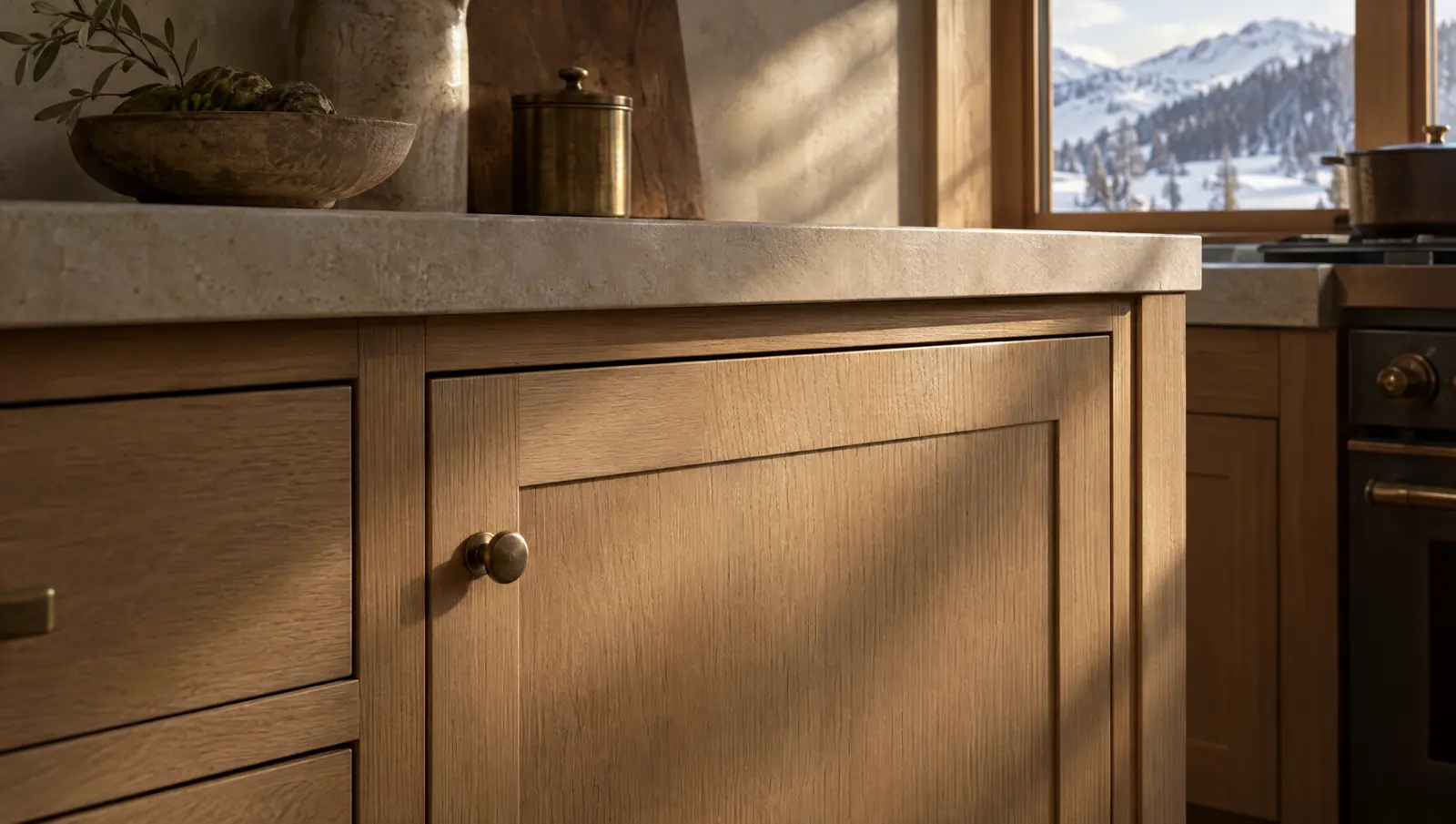
Solid wood never stops trading moisture with the air around it, and a heated Front Range house in January has some of the driest indoor air most cabinetry will ever see. Doors that closed cleanly in August can show a hairline crack at a painted joint, a lighter stripe at the edge of a stained panel, or an inset door that suddenly looks loose in its frame. None of that means the cabinets were built badly. It means wood is doing what wood does, and the kitchen was or was not planned for it.
Why Does Wood Move When the Furnace Comes On?
Wood gains or loses water until it matches the humidity of the room. Foresters call the end point equilibrium moisture content, and the USDA Forest Products Laboratory publishes the relationship in its Wood Handbook. The numbers below come from the Handbook's equation at 70 degrees Fahrenheit.
| Indoor relative humidity | Wood settles at about | What it usually means |
|---|---|---|
| 50% | 9.2% moisture | Humid summer conditions in many parts of the country |
| 40% | 7.7% moisture | A comfortable middle ground |
| 30% | 6.2% moisture | A humidified Colorado house in winter |
| 20% | 4.5% moisture | An unhumidified house on a cold day |
| 10% | 2.5% moisture | The far dry end of a cold snap |
The swing from 50 percent to 20 percent humidity takes about 4.7 points of moisture out of the wood. That is enough to matter, because wood shrinks as it dries and swells as it takes water back.
How Dry Does a Colorado Kitchen Get?
Drier than most owners expect. Cold air holds very little water, so when the furnace warms it, its relative humidity collapses. Using standard vapor pressure figures, outdoor air at 20 degrees F and 60 percent humidity, heated to 68 degrees, sits near 9 percent humidity before cooking, showers and people add some moisture back. At 0 degrees and 70 percent it falls to about 4 percent. The Front Range adds a dry climate and frequent cold, sunny days on top of that physics.
The season starts in October, when furnaces start running every night, and the driest stretch usually runs from December into February. Spring brings the wood back toward its summer size.
Which Way Does a Cabinet Door Move?
Almost all of the movement happens across the grain. Along its length a board barely changes. Across its width it changes a great deal, and flat-sawn boards move about twice as much as quarter-sawn or rift-sawn boards.
A worked example shows the scale. The Wood Handbook gives flat-sawn red oak a tangential coefficient of 0.00369 per point of moisture change. A 15 inch wide flat-sawn oak panel that goes from 9.2 percent to 4.5 percent loses about a quarter of an inch in width. Quarter-sawn stock of the same width, which moves at the radial rate of 0.00158, changes by roughly an eighth of an inch. Rift-sawn falls between the two.
- Door panels in a five-piece door float in a groove so they can shrink and swell without splitting the frame.
- Rails and stiles stay nearly the same length, because their grain runs the long way.
- Wide slab doors and drawer fronts in solid wood are the most exposed, which is why many are built from veneer over a stable core.
What Owners Notice, and What Causes It
IfA stained door shows a pale stripe along the panel edge
ThenThe panel shrank and pulled unfinished wood out of the groove. Panels finished before assembly do not show this.
IfInset doors look loose with wider gaps
ThenExpected in winter. If the same doors rub in July, the reveal was cut too tight for summer.
IfA panel rattles when the door closes
ThenThe panel has shrunk inside its groove. Small rubber spacers in the groove, standard in good shops, stop it.
IfA solid wood countertop or open shelf cups
ThenOne face is drying faster than the other. Finish both faces equally and fasten with slotted holes that let it move.
What Humidity Should You Keep?
Start with the cabinet maker's care and warranty documents, which usually name an indoor humidity range and expect you to stay inside it. In a Colorado winter, reaching that range normally means a humidifier, either a whole-house unit on the furnace or room units in the kitchen and adjoining spaces.
There is a ceiling as well as a floor. On the coldest nights, indoor air that is too humid condenses on window glass and frames. Many owners run a little lower during cold snaps and come back up as the weather eases. A small hygrometer near the kitchen, which costs little and tells the truth, beats guessing from how the air feels.
Plan Cabinetry for Both Seasons
Most winter problems are settled long before installation, in the shop drawings and material choices for the custom cabinetry.
- Choose rift-sawn or quarter-sawn stock for wide stained parts where movement would show.
- Specify floating panels finished before assembly, with spacers in the grooves.
- Use MDF or veneered panels behind paint, and accept that a joint line may still appear.
- Cut inset reveals for the season they are installed in. A door fitted in January needs room to grow by July.
- Let cabinets and doors acclimate in the heated house before final fitting.
- Decide on humidification during kitchen design, while the mechanical work is still open.
Questions Owners Ask
Are cracks at painted cabinet door joints a defect?
Usually not. A fine line at the rail and stile joint of a painted five-piece door comes from the wood shrinking under a continuous paint film. It tends to close or soften as humidity rises in spring.
Does altitude itself dry out wood?
Not directly. Wood responds to relative humidity and temperature. Altitude matters because the Front Range climate is dry and cold winter air holds little water once it is heated.
Should I wait until summer to install new cabinets?
No. Cabinets can go in at any time of year if the shop and installer allow for the season, especially on inset doors and wide solid parts.
Planning new cabinetry for a Colorado house? Send us a project brief and we will start with how your home handles winter.