

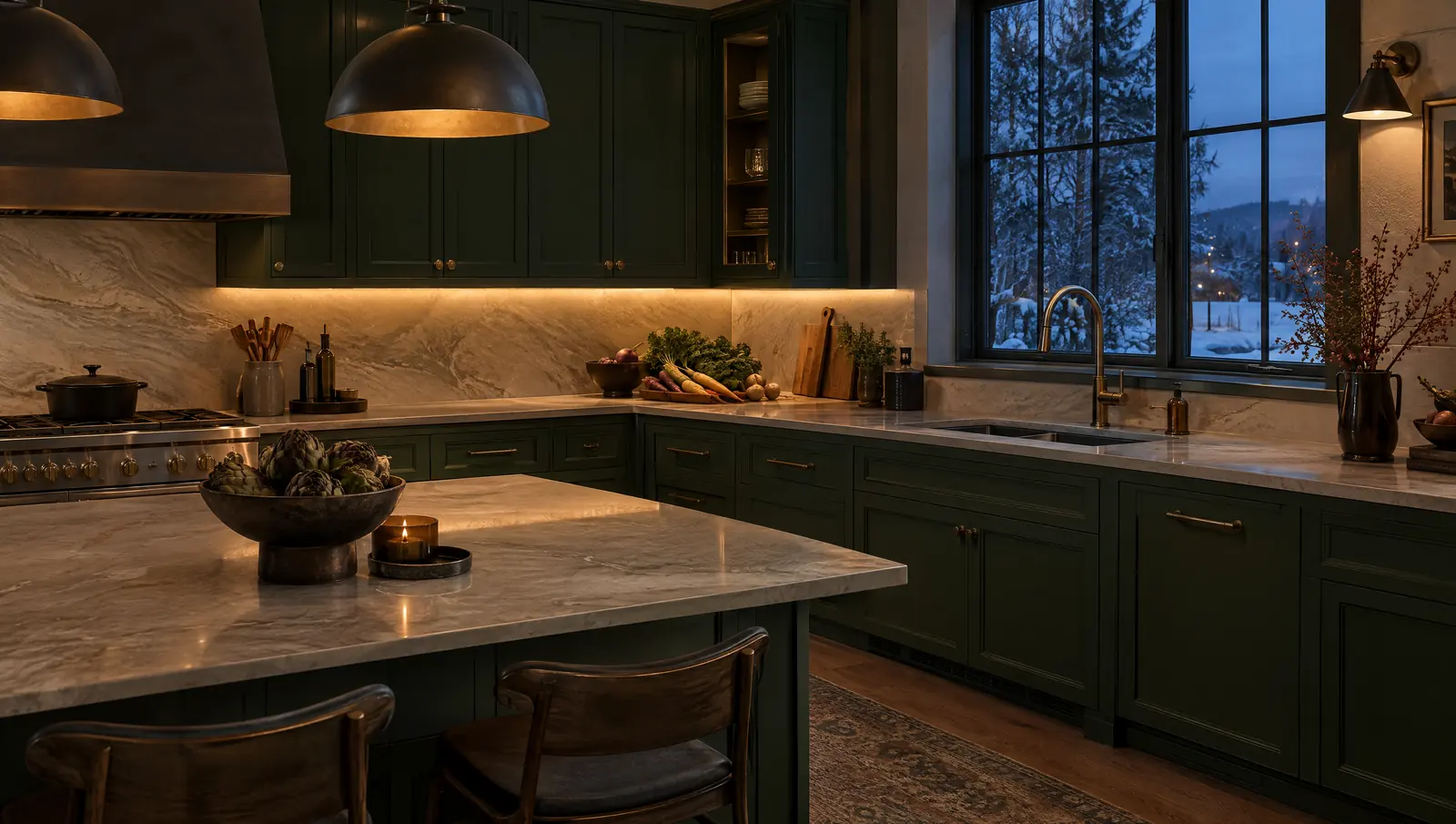
By the first week of December the sun sets in Denver at about 4:35 in the afternoon, and on the winter solstice the city gets roughly 9 hours and 21 minutes of daylight, against nearly 15 hours in June. In practice that means most weekday dinners are prepped under electric light for four months of the year. Under-cabinet lighting does more of that work than any other fixture in the room, so it deserves a proper specification and not a box of puck lights chosen at the end of the job.
Compare the Three Common Fixture Types
Almost every under-cabinet system on the market is one of three things. The differences show up on the counter, in the reflection on polished stone, and in what you see from a bar stool.
| Fixture | Light on the counter | On polished stone | Best use |
|---|---|---|---|
| LED tape in an aluminum channel with a diffuser | Continuous and even | A soft line, no dots | Custom cabinetry where the channel can be recessed |
| Linear LED bar | Even, with small gaps between bars | Usually clean | Retrofits and runs where tape is impractical |
| Puck lights | Pools of light with darker spots between | Visible bright spots | Accent inside glass cabinets, not task light |
For task lighting on a working counter, we recommend continuous tape in a channel with a diffuser. It gives the most even light, and the channel doubles as a heat sink that helps the LEDs last.
Specify These Six Things
A fixture's spec sheet answers most of the questions that matter. These are the lines worth reading.
- Color temperature. Match the rest of the kitchen. 2700K to 3000K keeps oak, limestone and bronze looking warm. Mixing a 4000K strip with 2700K pendants makes the counter look blue next to the island.
- Color rendering. Ask for a CRI of 90 or higher, and look for the R9 value as well. CRI is an average of eight pastel test colors and leaves out saturated red, which R9 measures. Red tells you whether meat looks cooked and tomatoes look ripe.
- Color consistency. Good manufacturers bin their LEDs and state it in MacAdam steps. Three steps or fewer means two strips from different boxes look the same color side by side.
- Output. Compare lumens per foot between products, and choose a version bright enough that you dim it down most evenings instead of wishing it were brighter.
- Voltage. 24-volt tape carries a longer run before the far end dims than 12-volt tape does, which matters on long perimeter runs.
- Dimming. The driver, the dimmer and the tape have to be compatible. Driver spec sheets name the dimming method they accept, and that method decides which wall dimmer works.
Put the Light Near the Front
Where the strip sits under the cabinet changes the result more than any product choice. Mounted at the back, against the wall, it lights the backsplash brightly and leaves the front of the counter, where your hands are, in relative shadow. Mounted toward the front, just behind the face frame or light rail, it lights the work surface and still washes down the backsplash.
Two details finish the job. A small light rail on the underside of the upper cabinets hides the fixture from anyone seated at the island. A recessed channel keeps the strip from becoming a visible stripe of hardware when you stand back from the room. Both are far easier to build into a kitchen design than to add once the cabinets are hung.
Decide How the Lights Are Switched
IfYou cook most evenings after dark
ThenPut under-cabinet lights on their own dimmer by the main entry, separate from ceiling lights.
IfThe kitchen opens to a family room
ThenDimmed under-cabinet light makes a good evening level for the whole space once the overheads are off.
IfThere is a separate coffee or bar area
ThenGive it its own circuit so an early morning does not light the whole kitchen.
IfYou are replacing old halogen or xenon pucks
ThenPlan new wiring and drivers. The power supplies and switches that ran them are rarely suited to LED.
Adding Lights to Existing Cabinets
Retrofitting is possible but limited by what is already there. Without a light rail, the fixture is visible. Without a wire path, the cable runs exposed or the wall gets opened. Without a reachable spot for the driver, plug-in bars become the only practical option. When under-cabinet lighting is one of several complaints about a kitchen, it is often a sign that a broader kitchen remodel will answer more of them at once.
If your winter evenings start at 4:30, plan the lighting with the rest of the kitchen. Send us a project brief and tell us how you use the room after dark.