

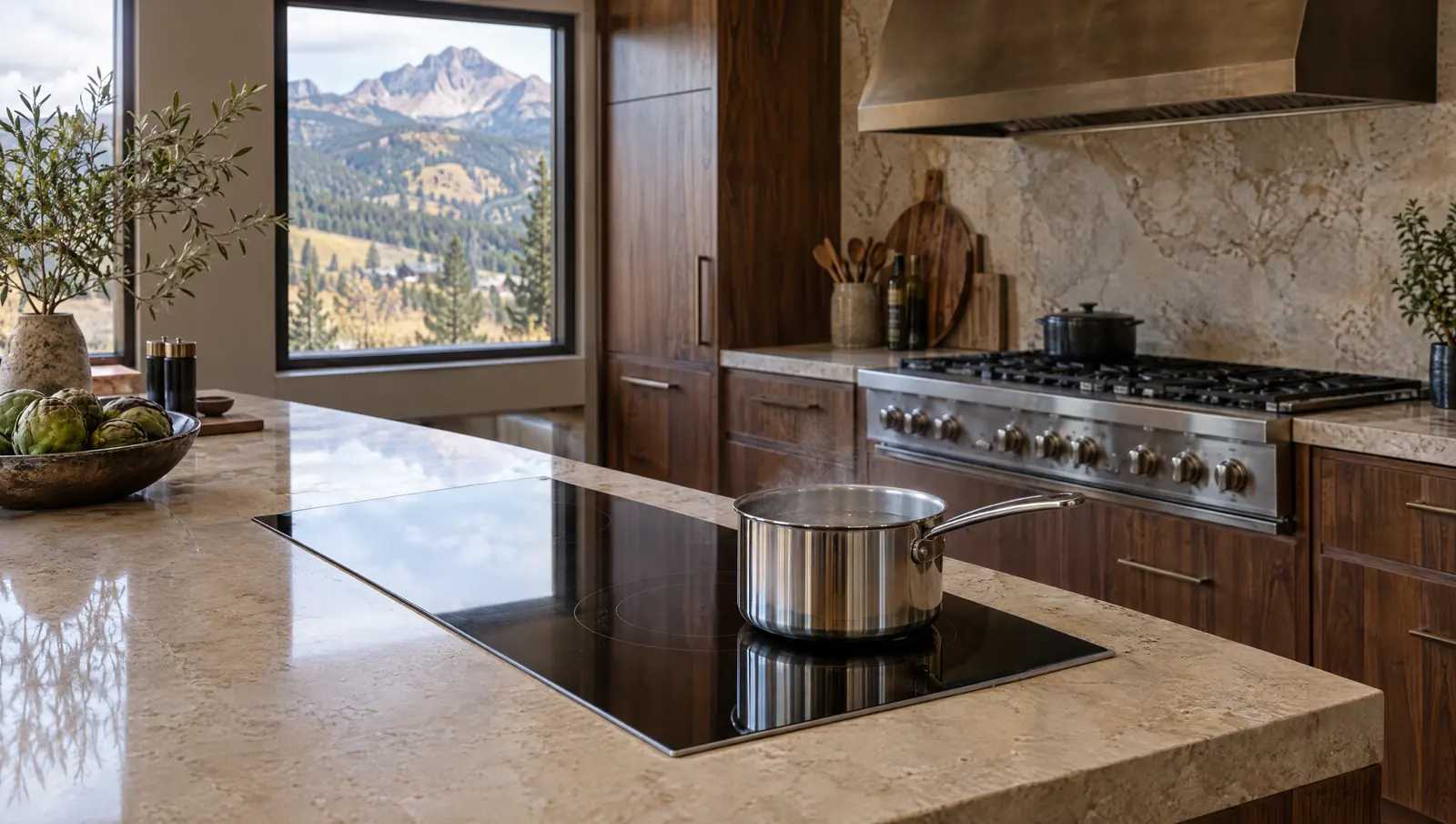
Altitude changes gas cooking in a way it does not change induction, and that single fact settles more Front Range cooktop debates than any brochure. A gas burner's flame depends on the air around it. An induction element depends on electricity. Above about a mile, that difference shows up in everyday cooking and in the installation paperwork.
Induction and Gas, Side by Side
| Question | Induction | Gas |
|---|---|---|
| Does altitude reduce output? | No. Electrical power is unaffected by air pressure. | Yes. Burners are derated, about 4% per 1,000 feet above 2,000 feet under the National Fuel Gas Code unless the manufacturer says otherwise. |
| Does water boil hotter? | No. It boils near 202 degrees F in Denver either way. | No. Same boiling point. |
| Response when you turn it down | Immediate, like gas | Immediate |
| Heat into the room | Little, since the pan is the heat source | More, from the open flame |
| Combustion byproducts indoors | None | Yes, which is one reason to vent the hood outdoors |
| Cookware | Must be magnetic | Anything |
| Round-bottom wok, charring over flame | Needs a specialty wok element, or not possible | Natural fit |
| Power outage | Does not work | Many surface burners can be lit by hand per the manual; check yours |
| Cleaning | Flat glass that stays cooler | Grates, caps and burner heads |
What Altitude Does to a Gas Burner
Burner ratings in BTUs are stated at sea level. Thinner air carries less oxygen per cubic foot, so the gas input has to come down to keep the flame burning cleanly. The National Fuel Gas Code reduces input by about 4 percent for every 1,000 feet above 2,000 feet when the manufacturer gives no other instruction. At Denver's 5,280 feet that is roughly 13 percent. In Monument, near 7,000 feet, it is about 20 percent.
So a burner advertised at a high sea-level rating delivers noticeably less in a Colorado kitchen. That does not make gas a poor choice. It means the number on the spec sheet is not the number on your stove, and the high-altitude section of the installation guide matters. Some models need a conversion or adjustment above a stated elevation, and that should be confirmed before the range is ordered.
What Altitude Does Not Change
Several common beliefs fall apart on inspection.
- Induction does not make water boil hotter. Water boils at a lower temperature at altitude because of air pressure, whatever heats the pot. Induction gets it to a boil faster; the pasta still cooks in 202 degree water in Denver.
- A bigger gas burner does not fix slow pasta. Once water is boiling, more heat only makes it boil harder, not hotter.
- Altitude does not affect an electric oven's temperature. Baking problems at altitude come from the recipe, and Colorado State University Extension publishes the adjustments.
- Induction is not only for modern kitchens. The glass top can sit in a stone counter under a traditional plaster hood, and a range-style induction unit can look like any other range.
Plan the Installation Before You Choose
Each option comes with its own utility work, and it is far easier to plan during kitchen design than to discover on install day.
Induction cooktops and ranges usually need a dedicated 240-volt circuit, and many 30 and 36 inch units call for 40 or 50 amps. The installation guide for the exact model settles the size. Older houses on the Front Range sometimes need an electrical panel review before adding that load. Gas needs a properly sized supply line, a shutoff, the high-altitude setup the manufacturer specifies, and a hood vented outdoors. A large hood can also trigger make-up air requirements under the residential code.
Choose by How You Cook
IfYou boil, sear and simmer most nights and want speed
ThenInduction gives full rated power at any elevation and fine control at low settings.
IfYou cook with a round wok or char peppers over a flame
ThenGas, or an induction cooktop paired with a dedicated gas wok burner.
IfYour cookware is mostly copper, aluminum or glass
ThenTest it with a magnet first. If the magnet will not stick, budget for new pans with induction.
IfThe kitchen is open to living space and you entertain
ThenInduction keeps heat off guests and has no open flame near the island.
IfPower outages worry you
ThenGas surface burners that can be lit by hand, confirmed in the manual, keep you cooking.
Questions Owners Ask
Does induction work at high altitude?
Yes. Induction heats the pan through a magnetic field powered by electricity, and its output does not depend on air pressure.
Is induction safe with a pacemaker?
Induction cooktop manuals include guidance for people with pacemakers and other implanted devices. Read it, and ask the doctor who manages the device before choosing.
Do I need a conversion kit for a gas range in Colorado?
It depends on the model and your elevation. The manufacturer's installation guide states when a high-altitude adjustment or kit is required.
Deciding between induction and gas for a new kitchen? Send us a project brief with your elevation and how you cook.