

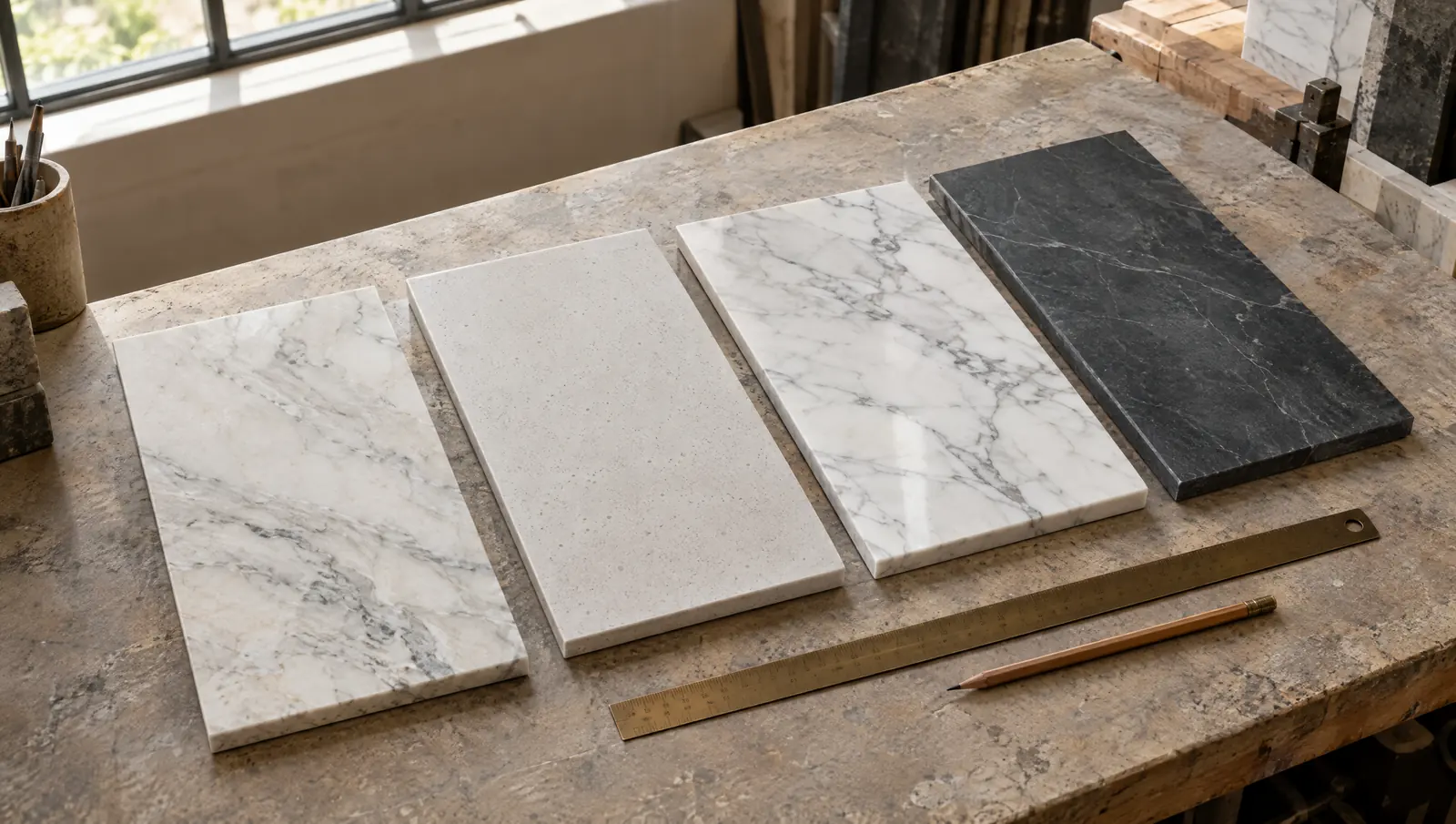
Quartzite and quartz sound like the same material and behave like different ones. Quartzite is a natural stone cut from a quarry. Quartz countertops are engineered slabs made mostly from crushed quartz held together with resin. Add marble and soapstone, the two other stones owners most often weigh for a high-end Colorado kitchen, and the useful comparison stops being about color. It becomes about what each surface does with a lemon, a hot pan and ten years of daily use.
How the Four Surfaces Compare
| Material | What it is | Scratches | Acids (lemon, vinegar, wine) | Heat | Sealing |
|---|---|---|---|---|---|
| Quartzite | Natural metamorphic stone, mostly quartz | Very resistant; quartz is 7 on the Mohs scale | True quartzite does not etch | Tolerates heat well; use trivets anyway | Usually sealed; porosity varies by slab |
| Engineered quartz | Crushed quartz bound with polymer resin and pigment | Resistant | Does not etch | The resin can scorch or discolor; manufacturers ask for trivets | Not needed |
| Marble | Natural stone made of calcite or dolomite | Scratches; calcite is 3 on the Mohs scale | Etches into dull marks | Tolerates heat well | Sealed against stains; sealing does not stop etching |
| Soapstone | Natural stone rich in talc | Scratches easily; marks can be sanded or oiled out | Does not etch | Tolerates heat well | Not needed; mineral oil darkens it evenly |
Quartzite: Hard, Natural and Sometimes Mislabeled
Real quartzite starts as sandstone and is recrystallized under heat and pressure until the quartz grains fuse. The result is hard, takes a polish, and carries the soft veining many people want from marble without marble's sensitivity to acid. It is also among the harder stones to fabricate, so edge profiles and sink cutouts deserve a fabricator who works with it regularly.
The trade name on a slab is not a geological test. Some stones sold as quartzite contain enough calcite or dolomite to behave like marble, etching under lemon juice and scratching more easily than a true quartzite would.
Engineered Quartz: Consistent and Low Maintenance
Engineered quartz is made in a factory, so color and pattern are uniform from slab to slab, which helps on long runs and large islands. It needs no sealing and resists stains. Its weak point is the resin binder. Manufacturers warn against setting hot cookware directly on the surface, and many do not cover outdoor use because sunlight can change the color of some products. On the Front Range, where sun is strong at altitude, a west-facing kitchen with long afternoon light through large windows is worth mentioning to the supplier.
Marble: Beautiful, and It Will Change
Marble is calcite or dolomite, both of which react with acids. A drop of citrus, vinegar or wine leaves a dull etch mark on a polished surface, and no sealer prevents that. Sealer slows staining; it does not stop etching. Honed marble shows etching far less than polished marble because the whole surface is already matte. Owners who choose marble usually accept the patina that develops, and it suits some kitchens better than a surface that never changes.
Soapstone: Soft, Dense and Forgiving
Soapstone's talc content makes it soft enough to scratch with a fingernail in some slabs, and dense enough that it does not need sealing. It does not etch, and it shrugs off heat. Scratches can be sanded out or blended with mineral oil, and oiling darkens the stone to a deep charcoal. It is usually quarried in smaller slabs, which can mean more seams on a large island, so check slab sizes before you plan the layout.
Match the Stone to the Kitchen
IfYou want the look of marble without etching
ThenQuartzite, after testing a sample of the actual slab.
IfYou want a uniform surface with the least upkeep
ThenEngineered quartz, with trivets near the range.
IfYou like a surface that records its use
ThenHoned marble, or soapstone for a darker palette.
IfThe island is very large
ThenCheck slab dimensions first. Seam placement is a design decision, not something to leave to install day.
Stone also changes the cabinetry under it. Heavy natural slabs, long overhangs and undermount sinks all affect how the cabinets are built and supported, which is why we choose stone alongside the custom cabinetry and the rest of the kitchen design, not after them.
Questions Owners Ask
Is quartzite harder than quartz countertops?
Both are mostly quartz, which rates 7 on the Mohs scale, so both resist scratches well. The practical difference is heat: quartzite has no resin binder to scorch.
Do quartzite countertops need sealing?
Usually, yes. Porosity varies from slab to slab, so ask the fabricator to test the stone and recommend a sealer and a schedule.
Choosing stone for a new kitchen? Send us a project brief and include any slabs you already have on hold.