

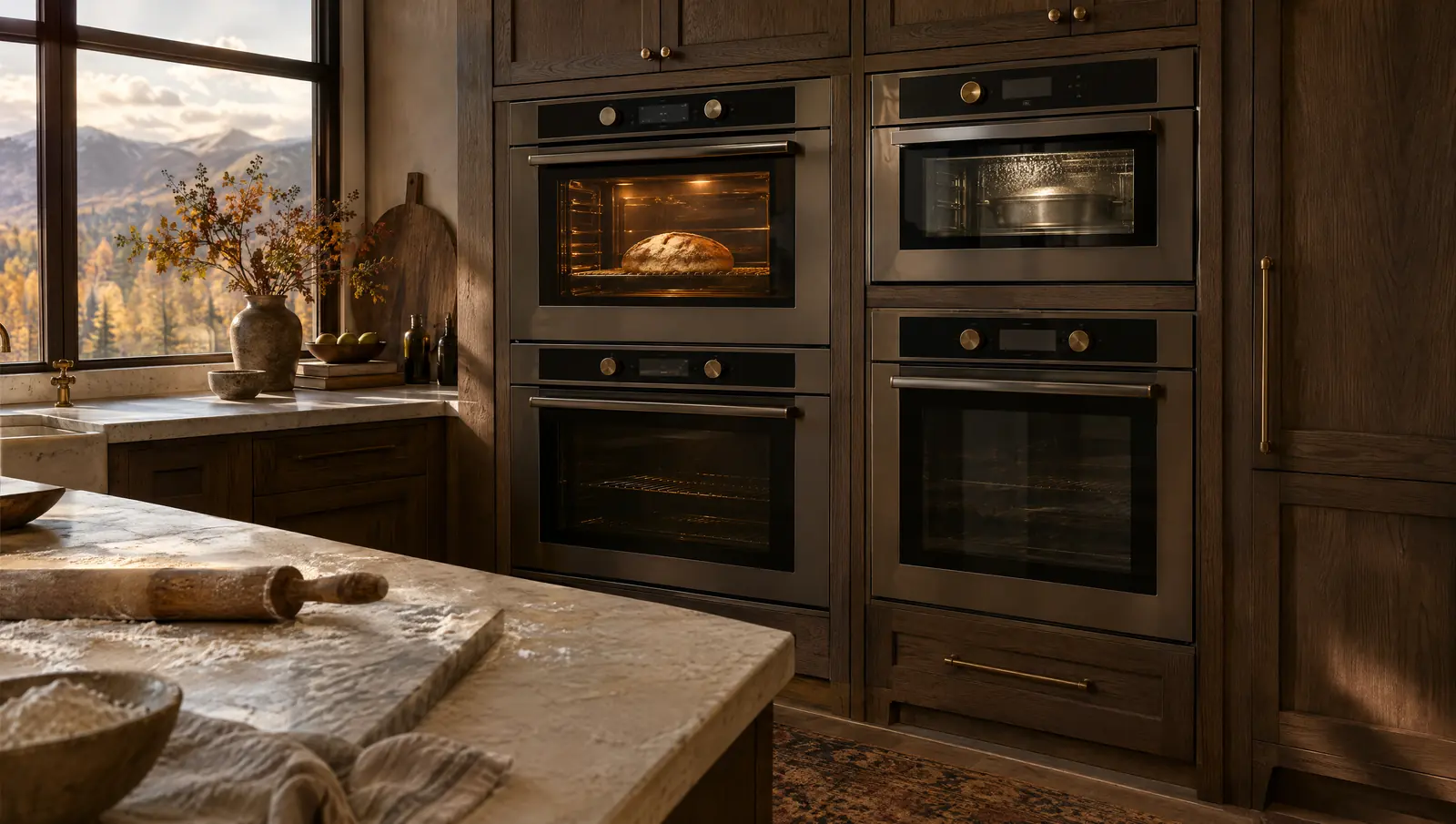
When a holiday cake domes, cracks and sinks in a Front Range kitchen, the oven usually isn't the cause. Lower air pressure is, and no appliance can change that. A good oven can still make the fixes easier to carry out, and some oven features answer specific altitude problems better than others.
What Altitude Does to Batter and Dough
Colorado State University Extension publishes high-altitude baking guidance that explains the physics clearly. With less air pressure overhead, the gases from baking powder, baking soda and yeast expand faster and further. A batter can rise quickly and then fall before its structure has set. Water boils at a lower temperature, so moisture leaves faster during the bake, and as it goes the sugar left behind becomes more concentrated, which weakens the crumb. Colorado's dry air adds to that evaporation, even before anything goes in the oven.
CSU Extension's adjustments are mostly recipe changes: less leavening, less sugar, more liquid, and for many cakes and quick breads a hotter oven with a shorter bake so the structure sets before the gases overexpand. The guidance commonly suggests raising the temperature by roughly 15 to 25 degrees Fahrenheit, with the details depending on elevation and recipe. Check the current CSU Extension publication for the numbers that match your home's elevation.
Match Each Altitude Problem to an Oven Feature
The table below pairs the failures bakers see at altitude with the oven capabilities that respond to them. None of these require a particular brand.
| Altitude problem | Oven feature that helps |
|---|---|
| Batter rises fast, then collapses before it sets | Stable temperature control and a quick, reliable preheat, so the hotter setting is actually reached when the pan goes in |
| The recipe fix calls for a hotter oven, but the oven runs cool | A user calibration offset in the settings menu, checked against an independent oven thermometer |
| Shorter bake times make overbaking easy | A temperature probe and precise timers that can end a cycle automatically |
| Uneven browning across several sheets of cookies | True convection, meaning a fan with its own heating element, plus racks spaced for airflow |
| Delicate cakes dry or crust over too soon | The option to bake with the fan off, or a low fan speed |
| Bread crust hardens early and loaves dry out | Steam injection or combination steam modes that keep the surface moist early in the bake |
| Dough proofs unpredictably in dry indoor air | A proofing mode with low, steady heat, ideally with added humidity |
How Steam Ovens Behave at Altitude
A steam oven is the feature most often asked about for high-altitude baking, and it earns that attention for bread. Moisture in the cavity during the first part of a bake keeps the crust soft long enough for the loaf to expand, then the oven dries out so the crust can brown. Combination steam ovens, which pair steam with convection heat, can also help enriched doughs and some custards hold moisture that dry Colorado air would otherwise pull away.
Two altitude details matter. First, because water boils at a lower temperature here, a pure steam mode tops out lower than it would at sea level. Some models ask for your elevation during setup so they can adjust steam generation and descaling prompts; read the owner's manual before you buy to see whether yours does. Second, steam ovens come in plumbed versions, with a water supply and drain, and reservoir versions that you fill by hand. Plumbed units are more convenient but need those connections planned inside the cabinetry. Many combination steam cavities are also smaller than a standard wall oven, so compare interior dimensions against your largest pan.
A Buying Checklist for Front Range Bakers
- Read the manual for a temperature calibration offset, and plan to verify it with an oven thermometer after installation.
- Look for true convection with a fan-off or low-fan option.
- Decide between a plumbed and a reservoir steam oven before cabinetry is drawn.
- If you choose gas, confirm the model's high-altitude instructions in its installation guide.
- Check the electrical requirements for each oven, since wall ovens and combination steam units usually need dedicated circuits sized to the manufacturer's specification.
- Measure interior width and depth against your sheet pans and roasting pan.
- Plan a landing surface beside every oven; the National Kitchen & Bath Association publishes planning guidelines for this.
Oven height and placement shape how often you actually check a bake. A wall oven set so the door opens near counter height is easier to watch during a short, hot bake, and this belongs in early kitchen design planning alongside clearances and lighting. If adding a plumbed steam oven or a second wall oven means new water, drain or electrical runs, that work is best scheduled as part of a full kitchen remodeling project so the trades arrive in the right order.
Ifyou bake bread every week
Thenput a combination steam oven at the top of the list.
Ifyou mostly bake cakes and cookies
Thenprioritize accurate temperature, calibration and selectable convection over steam.
Ifholiday baking means several recipes at different temperatures
Thenplan two ovens, such as a full-size convection oven paired with a combination steam oven.
Ifyou can't add a water line without opening walls
Thenconsider a reservoir steam oven.
Questions Owners Ask
Will a convection oven fix my high-altitude baking problems?
It helps with even browning and multiple sheets, but it won't stop a batter from overrising. Recipe adjustments still do most of the work.
Should I test my current oven before replacing it?
Yes. Place an oven thermometer in the center, preheat, and compare readings. If the oven runs cool and has a calibration setting, correcting it may solve the problem.
If you're planning new ovens as part of a kitchen, send us a project brief and we'll reply with next steps.